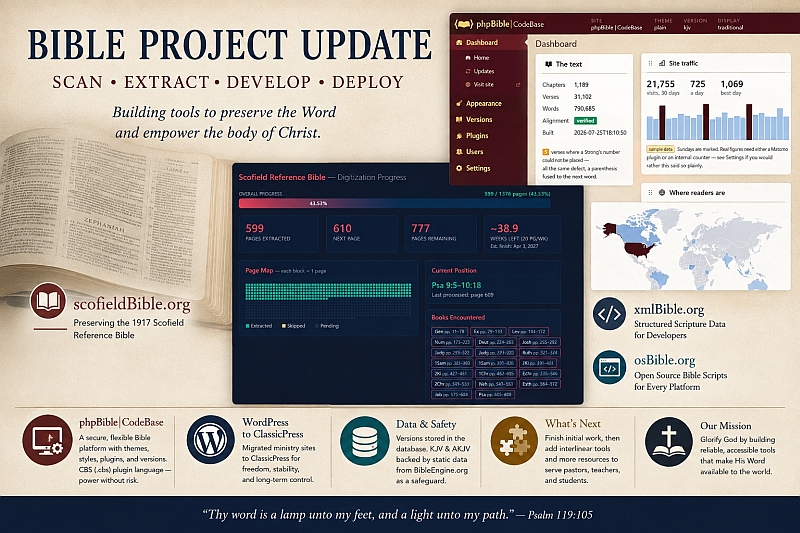
Note: This newsletter was compiled by the Claude.ai, based on data from site trafficking and work logs. It is based on instruction I gave it, and the proofed by me for accuracy. –Danny
ScofieldBible.org — seventy pages, two Gospels finished
The page-by-page transcription of the 1917 Scofield Reference Bible ran ten scan pages a day, every day, for all seven days of this week — seventy pages, carrying the work from Luke 20:27 through Acts 18:15. Luke was finished Sunday morning and John was opened within the hour. John was finished Thursday afternoon, and Acts was opened the same afternoon. By Saturday evening Acts had been taken past chapter eighteen, which is more than halfway through the book.
What a page costs is not obvious from the count. Across those seventy pages, roughly 1,650 center-margin cross-reference anchors were recorded and tied to the exact word they hang on, along with the outline headings, the footnote bands, the chain references, and the words the King James translators supplied and set in italics. Better than half the pages break in the middle of a verse, and a good many break in the middle of a footnote — so the tail of one page has to be carried forward and joined to the head of the next without losing a letter. Nine of the seventy carried a footnote across the break that way.
xmlBible.org — 1 and 2 Timothy
Two more books went into the collection this week, both of them right on the first build. 1 Timothy on Monday, the fifty-fourth book: six chapters, 113 verses, 1,637 Greek words set alongside the English. 2 Timothy on Wednesday, the fifty-fifth: four chapters, 83 verses, 1,272 Greek words. The collection now stands at 55 books, 1,129 chapter files and 29,893 verses, all of it checked clean. That is three books in a row that went from first inspection straight to publication with nothing needing to be diagnosed or repaired in between.
One thing worth reporting is a check that finally earned its keep. Some English words in the source are broken across two tags and have to be stitched back together; a bad stitch drops a space into the middle of a word, which is the kind of fault no other test can see. That check had been passing for several books running — but every one of those books happened to contain no split at all, so it had been passing on an empty room. 1 Timothy has five. All five were stitched and the finished book carries no trace of the seams. A check that has never met the thing it is looking for is not yet evidence of anything.
phpBible|CodeBase — a week of unglamorous corrections
Most of Friday went to a study of whether kjav.us, the private short-link service used for our own Bible sites, could be opened up to any church running the software. Nothing was built; the session was spent working out whether the idea holds up. It turned up three faults live on the service right now, including one where a reference to Judges quietly sends the reader to Jude. It also turned up a small thing with real consequences in print: the underscore currently used between chapter and verse falls outside the compact character set QR codes use, and a single one of them forces the whole code into a denser, larger pattern. A full stop does the same job and stays inside the set. For anything printed on a bulletin or a card, that is the difference between a code that scans easily and one that does not.
The rest of the week was spent finding things that were already wrong. The published package could not have installed itself — the file holding all the book names was being deliberately left out of every release, while the installer demands it as its very first step. Sixteen megabytes were shipping by accident: a second copy of the Bible text that nothing in the running site ever opens, which cuts the download roughly in half now that it is gone. The public description was still advertising the old plugin design that was replaced two weeks ago, which meant it was understating our own security work to the very people deciding whether to trust it. And a formatting pass I had reported as verified turned out to have moved 1,078 lines one space to the right across 53 files. Nothing was broken by it and no visitor would ever have seen it — but I had said the work was verified, and a reasonable person hearing that would take it to mean the result was right rather than merely equivalent. It has been repaired from the untouched originals, and a rule added that no file may come out worse-indented than it went in.
Traffic — and a great deal of it wasn’t people
| Site | Visits | Avg/day | Change |
|---|---|---|---|
| phpBible.org (automated traffic) | 19,566 | 2,795 | ▲ 897% |
| Spurgeon’s Morning and Evening | 3,308 | 473 | ▲ 34.6% |
| Strong’s Concordance | 1,664 | 238 | ▲ 3.2% |
| My Open Bible | 953 | 136 | ▲ 18.2% |
| Country Hymns | 177 | 25 | ▲ 30.1% |
| Matthew Henry’s Commentary | 114 | 16 | ▲ 6.5% |
| MorningPsalm.org | 63 | 9 | ▲ 50% |
| ScofieldBible.org | 57 | 8 | ▼ 1.7% |
| SystematicTheology.us | 54 | 8 | ▲ 74.2% |
| kjBible.org | 34 | 5 | — |
| Nave’s Topical Bible | 26 | 4 | ▼ 88.4% |
| Vocabularium | 21 | 3 | ▼ 25% |
| Did You Pray First? | 20 | 3 | ▼ 39.4% |
| My Bible Memes | 9 | 1 | ▼ 10% |
| VirtualBible.org | 9 | 1 | ▼ 64% |
| BibleEngine.org | 4 | 1 | ▼ 50% |
| What My Dogs Taught Me Today | 2 | <1 | — |
| DannyCarlton.org | 0 | 0 | — |
| All sites | 26,081 | 3,726 | ▲ 244% |
| Excluding phpBible.org | 6,515 | 931 | ▲ 16% |
Figures are visits for August 16–22, 2026, from the network’s own analytics. A visit is a browser session, not a person. The prior week’s figures are reconstructed from the per-site change percentages rather than pulled separately, so treat them as close rather than exact. xmlBible.org and osBible.org redirect to GitHub, so no visitor figures exist for either — which this week means the two projects that had the most work done on them have no number in the table at all.
The headline number is not what it appears to be. phpBible.org shows 19,566 visits — nearly ten times the previous week — and almost none of it is human. The proof is not the size of the jump but a second figure beside it: those 19,566 visits produced only 2,632 page views. That is roughly one page for every eight visits, and a real person cannot open fewer than one page in a session. Take phpBible out and the rest of the network runs at 1.33 pages per visit, which is perfectly ordinary. So the distortion sits entirely on one site.
Whether to call it an attack, I honestly cannot say from the numbers alone. The pattern fits an automated scanner probing for weaknesses just as well as it fits a scraper harvesting content, and the two look identical from this side. What the numbers do settle is that it isn’t readers. The timing is suggestive — the phpBible|CodeBase software was announced publicly earlier this month, and newly announced software attracts automated attention. Nothing has been damaged and nothing is at risk; it is noise, and the honest thing is to label it as noise rather than count it as reach.
One other figure needs the same treatment in the opposite direction. Nave’s Topical Bible appears to have lost 88% of its traffic. It hasn’t. Nave’s has sat around a dozen or two visits a week for as long as it has been measured; this week’s 26 is normal and last week’s 224 was the anomaly — almost certainly a smaller automated run that has now ended.
For Perspective
Setting the automated traffic aside, the ministry sites were visited 6,515 times this week, an average of 931 a day. That is up about 16% on the previous week’s figure of roughly 5,614.
The Hartford Institute puts the median American congregation at 70 people in attendance on a given weekend. Measured against that, the sites were opened by the equivalent of about thirteen congregations every day, and about ninety-three across the week.
That comparison is worth making and worth qualifying in the same breath. A visit is a browser session, not a soul. One person reading on a phone at lunch and a laptop that evening is two visits. Somebody who lands on a page, sees it isn’t what they wanted, and leaves is also a visit. It is not the same thing as ninety-three congregations gathering, and I don’t want it read that way. But it does mean the King James text, Strong’s numbers, Spurgeon’s devotions and Scofield’s notes were put in front of people that many times this week, without a building, a service time, or anyone having to be invited.
Next Week
Scofield transcription continues through Acts. Hebrews went into xmlBible.org on Sunday morning — a day past the close of this report — so that story belongs in next week’s update, and it is a good one. And the phpBible|CodeBase app page still isn’t live; there is nothing to download yet, and I would rather say so plainly than keep promising it.