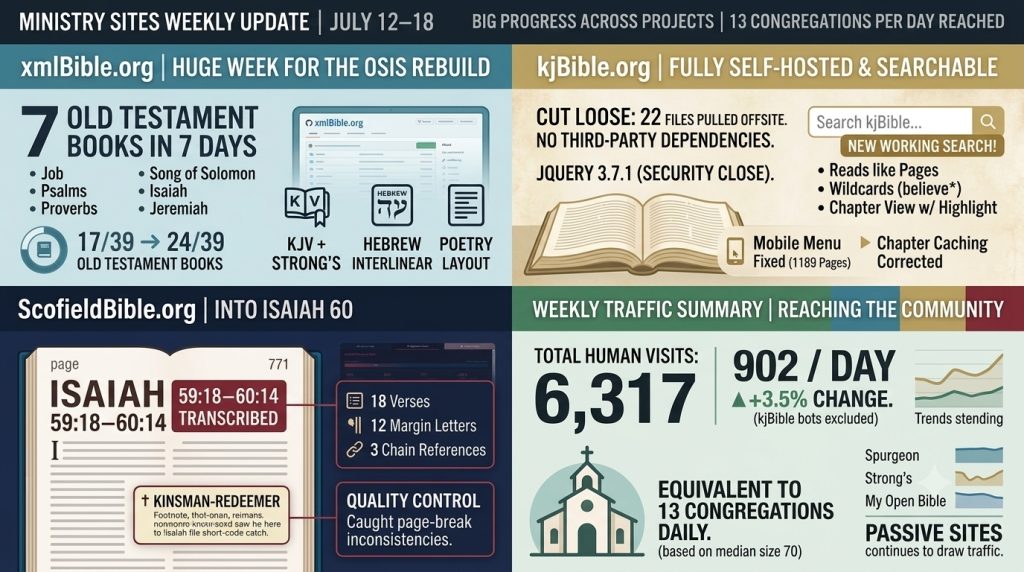
Seven books of the Old Testament went into the scholarly XML Bible this week — the biggest single week the project has had. kjBible.org cut its last ties to outside servers and finally got working search. Scofield transcription pushed on into Isaiah 60.
xmlBible.org — seven books in seven days
The OSIS rebuild went from 17 of 39 Old Testament books to 24. In order: Job (42 chapters), Psalms (150), Proverbs (31), Ecclesiastes (12), Song of Solomon (8), Isaiah (66), and Jeremiah (52). Every chapter carries the King James text with Strong’s numbers, Hebrew morphology, a word-for-word Hebrew interlinear, and Cambridge Paragraph Bible poetry layout.
Psalms was the hard one, and not for the reason you’d guess. The build had a silent bug that would have dropped 116 psalm superscriptions — “A Psalm of David, when he fled from Absalom his son” and the rest — out of the corpus entirely. Those titles are verse 1 in the Hebrew Bible. They are Scripture. The source file stores them outside the verse structure, so the build simply never looked at them, and both existing verification checks were structurally blind to the loss. They would have certified the broken corpus as clean.
Two more bugs surfaced in the same area. Long titles that span two Hebrew verses would have been spliced together and lost words. And the 22 acrostic stanza headings in Psalm 119 — ALEPH, BETH, GIMEL, and the rest — were leaking raw markup into the text as though it were Scripture. All three were fixed before Psalms was built, and two new verification checks were added so none of them can happen again unnoticed.
The lesson worth writing down: a test that can only see inside a verse cannot tell you when Scripture goes missing outside one.
Isaiah crossed into a new Hebrew source file, and a read-only probe beforehand caught that the file labels Joel and Nahum with different short codes than the builder uses — a problem found weeks before it would have stopped a build.
kjBible.org — cut loose from the outside, and searchable
Two sessions here. The first inventoried every offsite file the site was loading and found far more than expected: four visible ones, plus fourteen more buried inside the theme’s plugin loader, spread across four different content-delivery networks. All 22 were pulled down and now load from kjBible.org itself. The site fetches nothing from a third party anymore. jQuery went from 3.2.1 to 3.7.1, closing two known security holes.
The same pass turned up problems that had been live the whole time the static site existed. The mobile menu was silently broken on all 1,189 chapter pages. The ministry footer was being fetched from an outside server twelve separate times per build with failures ignored, so roughly 100 chapters had shipped with no footer at all. And the caching rule for chapter pages used a pattern that matched nothing, so every chapter was being served with no caching instructions.
The second session put search on the site. The search page, the word index, and the verse data were already there and already ran entirely in the browser — there was simply no way in. A search icon now appears in the header of every chapter page. Results are formatted to read like the pages themselves, wildcards work (believe* finds believed and believeth), and clicking a result opens the whole chapter with the verse highlighted in place.
ScofieldBible.org — into Isaiah 60
Page 771 of the 1917 Scofield Reference Bible was transcribed: Isaiah 59:18–60:14, with 18 verses, 12 margin letters across 15 anchors, three chain references, and the two-part footnote on the Kinsman-Redeemer.
The session also caught two quiet inconsistencies in how earlier pages had been stored. A word split across a page break was recorded one way on page 766 and the opposite way on page 770, which means a full-text search for “enemies” would find neither page. Both were flagged and documented before the pattern could spread further.
Traffic, week of July 12–18
| Site | Visits | Avg/day | Change |
|---|---|---|---|
| kjBible.org (bot-dominated) | 38,491 | 5,499 | ▲ 15.5% |
| Spurgeon’s Morning and Evening | 2,627 | 375 | ▲ 4.7% |
| Strong’s Concordance | 1,930 | 276 | ▼ 1.8% |
| My Open Bible | 844 | 121 | ▼ 1.5% |
| phpBible.org | 238 | 34 | ▼ 19.6% |
| Country Hymns | 198 | 28 | ▲ 20.7% |
| Matthew Henry’s Commentary | 113 | 16 | ▼ 13.7% |
| VirtualBible.org | 72 | 10 | ▼ 46.3% |
| Vocabularium | 65 | 9 | ▲ 225% |
| ScofieldBible.org | 64 | 9 | ▲ 30.6% |
| MorningPsalm.org | 62 | 9 | ▲ 14.8% |
| SystematicTheology.us | 35 | 5 | ▲ 66.7% |
| Nave’s Topical Bible | 29 | 4 | ▼ 45.3% |
| Did You Pray First? | 22 | 3 | ▼ 8.3% |
| My Bible Memes | 9 | 1.3 | — |
| What My Dogs Taught Me Today | 5 | 0.7 | ▲ 66.7% |
| BibleEngine.org | 4 | 0.6 | ▲ 100% |
| xmlBible.org | no data — redirects to GitHub | ||
| osBible.org | no data — redirects to GitHub | ||
| All sites | 44,808 | 6,401 | ▲ 13.1% |
| Excluding kjBible.org bots | 6,317 | 902 | ▲ 3.5% |
Notes on the table. xmlBible.org and osBible.org redirect to GitHub, so no visitor statistics exist for them at all — which means the week’s largest body of work sits on the one line in the table with no number beside it. MorningPsalm.org and VirtualBible.org are back in the export after being absent last week. And most of the sites listed here are passive ministries: built once, running unattended, needing nothing. A site can post real traffic with no work logged against it, and that is exactly the intent.
What the numbers actually mean
kjBible.org’s 38,491 visits are overwhelmingly automated crawlers, not people. Counting them as readers would be dishonest. Setting kjBible aside, the ministry sites drew 6,317 human visits for the week, or 902 a day — up about 3.5% from last week’s 6,101.
The Hartford Institute puts the median U.S. congregation at 70 weekly attenders. On that measure, these sites reach roughly 13 congregations’ worth of people every day, or about 90 congregations in a week. A mid-sized megachurch, arriving one browser at a time from every time zone.
The honest caveat stays where it belongs: a visit is a browser session, not a soul. Some are the same person twice. Some are thirty seconds and a bounce. But someone typed a word into a search box and landed on a Spurgeon devotional or a Strong’s entry, and that is not nothing.