Note: This newsletter was compiled by the Claude.ai, based on data from site trafficking and work logs. It is based on instruction I gave it, and the proofed by me for accuracy. –Danny
ScofieldBible.org — four books finished in seven days
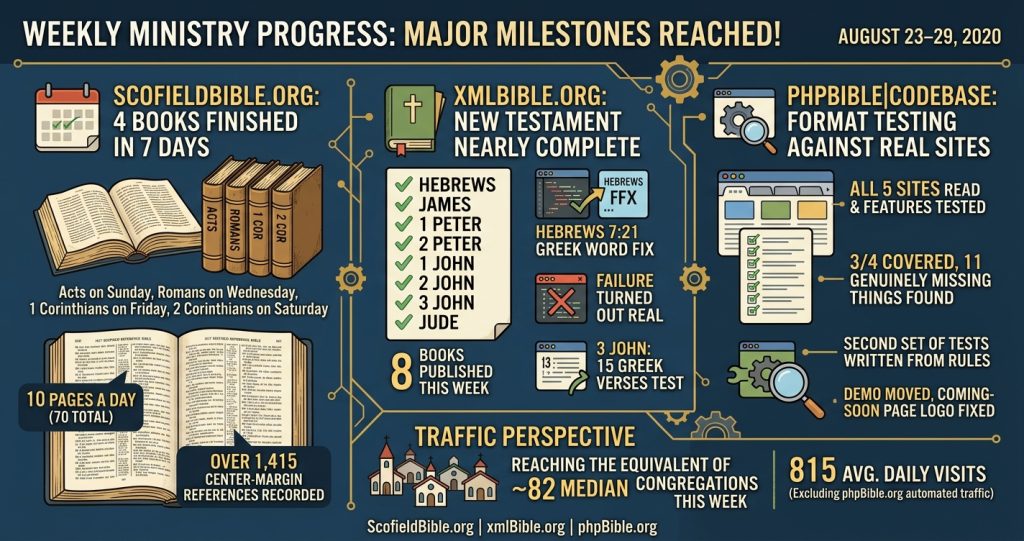
Seventy pages of the 1917 Scofield Reference Bible were transcribed this week — ten a day, every day, with no gaps. That carried the work from Acts 18 through to Galatians 3, finishing four whole books along the way: Acts on Sunday, Romans on Wednesday, 1 Corinthians on Friday, and 2 Corinthians on Saturday, with Galatians opened the same morning. Two pages of Scofield’s own front matter went in as well — his introductory notes to Paul’s letters, and his explanation of how the reference system works.
Roughly 1,415 center-margin cross-references were recorded across those seventy pages, on top of the outline headings, footnotes and chain references that each page carries. Romans and 1 Corinthians are the densest pages the project has met so far: several run past a full a–z cycle of margin letters and start over.
xmlBible.org — the New Testament all but finished
Eight books were published this week, taking the collection from 57 books to 65 of 66. Hebrews on Sunday, James on Monday, 1 Peter on Tuesday, 2 Peter on Wednesday, then 1 John, 2 John, 3 John and Jude to close the week. Every one carries the King James English joined word by word to the Greek behind it.
Two of them earned their checks. Hebrews would have lost eleven Greek words without a repair made two weeks earlier — at Hebrews 7:21 the relocated words arrive in the source file ahead of the verse’s own text, and the older software would have thrown away the verse’s own words rather than the incomers, silently. The build also failed on its first run and the failure turned out to be real, closing a question that had been open since Matthew in July. And 3 John turned up something the project had never seen: the Greek has fifteen verses where the King James has fourteen, with no English verse left behind to check the extra words against, so a different test had to be written for it.
xmlBible.org redirects to GitHub, so it has no visitor figures in the table below — the week’s largest single body of work appears nowhere in the traffic numbers.
phpBible|CodeBase — checking the format against real sites
All five of our Bible sites were read end to end and every feature on them tested against the new plugin format, to find where the format falls short before the software that reads it gets written rather than one redesign at a time afterwards. About three-quarters was already covered. Eleven things were genuinely missing, and they cluster in four places rather than being scattered — which is the useful part.
Later in the week, three features that had been recorded as finished turned out never to have been built at all, including one the format’s own published example depends on. All three were missed the same way: the tests had been fed the examples out of our own guides, which only ever tests what somebody happened to write down twice. There is now a second set of tests written from the rules themselves. The demo also moved to a simpler address, and the sliced brace in the logo at the top of the coming-soon page was fixed.
Traffic — August 23 to 29
| Site | Visits | Avg/day | Change |
|---|---|---|---|
| Spurgeon’s Morning and Evening | 2,559 | 366 | ▼ 22.6% |
| Strong’s Concordance | 1,545 | 221 | ▼ 7.2% |
| phpBible.org (possibly automated traffic) | 1,008 | 144 | ▼ 94.8% |
| My Open Bible | 959 | 137 | ▲ 0.6% |
| Country Hymns | 194 | 28 | ▲ 9.6% |
| ScofieldBible.org | 103 | 15 | ▲ 80.7% |
| Matthew Henry’s Commentary | 81 | 12 | ▼ 28.9% |
| MorningPsalm.org | 76 | 11 | ▲ 20.6% |
| kjBible.org | 57 | 8 | ▲ 67.6% |
| Did You Pray First? | 30 | 4 | ▲ 50.0% |
| SystematicTheology.us | 21 | 3 | ▼ 61.1% |
| Nave’s Topical Bible | 18 | 3 | ▼ 30.8% |
| BibleEngine.org | 16 | 2 | ▲ 300% |
| My Bible Memes | 16 | 2 | ▲ 77.8% |
| Vocabularium | 16 | 2 | ▼ 23.8% |
| VirtualBible.org | 15 | 2 | ▲ 66.7% |
| What My Dogs Taught Me Today | 1 | — | ▼ 50.0% |
| DannyCarlton.org | 0 | 0 | — |
| All sites | 6,715 | 959 | ▼ 74.3% |
| Excluding phpBible.org | 5,707 | 815 | ▼ 12.4% |
xmlBible.org and osBible.org redirect to GitHub and are not measured here, so neither appears above. Change is measured against the previous seven days, August 16 to 22, and this export reports it against visits rather than hits. The export was pulled after the week closed, so no partial day is included.
The 74% collapse in the all-sites figure is not a loss of readers. Last week phpBible.org recorded 19,566 visits that were plainly automated; this week it recorded 1,008. The run has largely ended, and the totals fell with it. What is left on phpBible.org still is not people: 1,008 visits produced only 202 pageviews, and a real visitor cannot read less than one page. Whether that is a vulnerability scanner or a scraper the numbers cannot say — only that it is not readers.
Setting phpBible.org aside entirely, the rest of the network drew 5,707 visits, or 815 a day. That is down about 12% from last week’s 6,515. Spurgeon’s Morning and Evening accounts for most of the drop on its own, down 749 visits with no change on our end to explain it. Excluding phpBible.org wholesale is the conservative choice — it discards whatever genuine readers that site had this week along with the automated traffic, though at 202 pageviews there were not many.
For Perspective
The Hartford Institute puts the median American congregation at about 70 people on a Sunday. At 815 visits a day, the ministry sites reached the equivalent of about a dozen such congregations every day this week, and roughly 82 across the week. A visit is a browser session and not necessarily a person, so this is a rough measure rather than a precise one — but it is the honest scale of the thing.
Next Week
Revelation went into the xmlBible.org collection on Sunday the 30th, one day past this window, and with it the whole King James Bible — all 66 books, 1,189 chapters, 31,102 verses. That story belongs to next week’s post, along with the phase that started immediately afterwards.