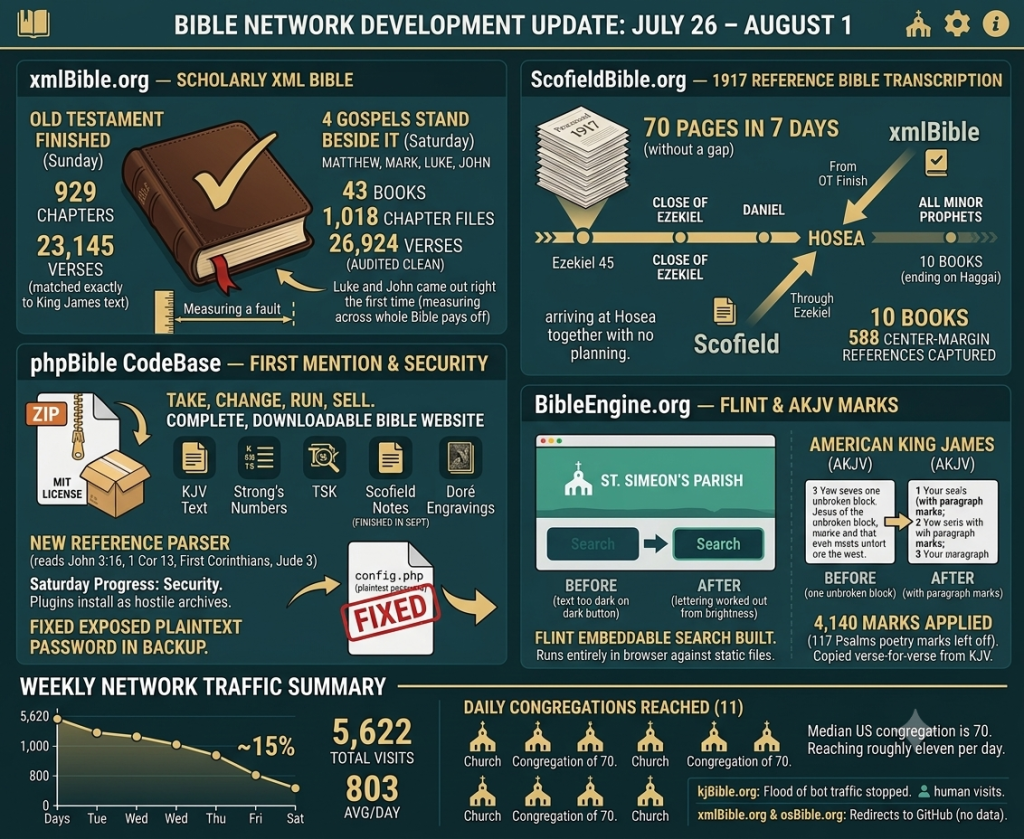
The Old Testament of the scholarly XML Bible was finished on Sunday, and by Saturday all four Gospels stood beside it. The Scofield transcription put ten books behind it in the same seven days, arriving at the Minor Prophets from the opposite direction. A new project gets its first mention here. And a plaintext password was found sitting somewhere it should never have been.
xmlBible.org — the Old Testament finished, and four Gospels
The Old Testament was finished on Sunday. Malachi was the thirty-ninth and last book, closing a corpus of 929 chapters and 23,145 verses, every verse matching the King James text exactly. The New Testament began the next day, and by Saturday all four Gospels were built, verified and published — Matthew, Mark, Luke and John. Forty-three books, 1,018 chapter files, 26,924 verses, audited clean. Matthew took three attempts and Mark two; Luke and John each came out right the first time, which is what measuring a fault across the whole Bible before repairing it buys you.
ScofieldBible.org — ten books in seven days
Seventy pages of the 1917 Scofield Reference Bible were transcribed this week — ten a day, seven days running, without a gap. That carried the work from Ezekiel 45 through the close of Ezekiel, then the whole of Daniel, Hosea, Joel, Amos, Obadiah, Jonah, Micah, Nahum, Habakkuk and Zephaniah, ending with Haggai opened. Ten books in seven days, and about 588 center-margin references captured along with them. xmlBible spent the same week in those same Minor Prophets from the other direction — two projects arriving at Hosea together, with no planning at all.
phpBible CodeBase — a first mention
This one has not been named here before, so it deserves a plain introduction. phpBible CodeBase is a complete Bible website that anybody will be able to download and run on their own server. Not a service, not an account, not a monthly fee — a package you unzip. It will carry the King James text, Strong’s numbers, the Treasury of Scripture Knowledge, Scofield’s 1917 notes (when finished in September) and the possibly the Doré engravings, every one of them public domain, and it will go out under the MIT license: take it, change it, run it, sell it, keep the copyright notice, and that is the whole obligation. It is being built. There is no site to visit yet and nothing to download, and there will not be until version 1.0.
Three sessions went into it this week. The reference parser the whole project had been waiting on was built Monday — it reads John 3:16, 1 Cor 13, Jn 3:16, First Corinthians and Jude 3 the way people actually write them, replacing a matcher under which thirty-four abbreviations pointed at more than one book and twenty-four pointed at the wrong one. Saturday was spent making the package safe to hand to a stranger: plugins now install from a zip file that the software treats as hostile, since a file inside an archive can claim to be ../../config.php and overwrite a site’s database password on the way out. Separating the finished package from the development tools turned up a live exposure in the process — a backup of this site’s own configuration file, database password in plain text, sitting where anyone could have downloaded it. It has been moved out of reach and a rule added so no file of that kind can ever be served again.
BibleEngine.org — Flint, and the missing paragraph marks
Flint was built this week — an embeddable Bible search that a site owner pastes into their own page as one script tag and a marker div. It runs entirely in the visitor’s browser against static files, so there is no account, no key, no quota, nothing to register and nothing to bill. The search engine itself does not download until somebody actually searches, so a box sitting in a sidebar across two hundred pages costs almost nothing until it is used. Building a demo of it — a pretend church website in green and teal, deliberately nothing like BibleEngine — found a real fault that reasoning had missed: the button’s lettering was fixed near-black against whatever colour the site owner chose, and was close to invisible on anything dark. It now works the lettering out from the brightness of the colour chosen.
The American King James text also received the printed paragraph marks it had never carried, which had left an AKJV chapter reading as one unbroken block no matter what setting the reader chose. All 4,257 marks in the King James sit at the very start of a verse and the two texts’ verse numbering lines up exactly, which turned a job that had been put off for fear of word-by-word matching into a straight verse-for-verse copy. 4,140 were applied; 117 were left off on purpose, because they belong to the Psalm titles, and the Psalms are poetry with no paragraphs to mark.
Traffic — week of July 26 to August 1
| Site | Visits | Avg/day | Change |
|---|---|---|---|
| Spurgeon’s Morning and Evening | 2,483 | 355 | ▼ 6.4% |
| Strong’s Concordance | 1,687 | 241 | ▼ 5.5% |
| My Open Bible | 749 | 107 | ▼ 33.4% |
| phpBible.org | 205 | 29 | ▼ 10.9% |
| Country Hymns | 113 | 16 | ▼ 38.9% |
| Matthew Henry’s Commentary | 81 | 12 | ▼ 16.5% |
| kjBible.org | 63 | 9 | ▲ 5.0% |
| MorningPsalm.org | 60 | 9 | ▲ 3.5% |
| ScofieldBible.org | 55 | 8 | ▼ 20.3% |
| VirtualBible.org | 37 | 5 | ▼ 76.0% |
| Nave’s Topical Bible | 24 | 3.4 | ▼ 42.9% |
| SystematicTheology.us | 18 | 2.6 | ▼ 62.5% |
| BibleEngine.org | 17 | 2.4 | ▲ 1,600% |
| Did You Pray First? | 14 | 2.0 | ▼ 57.6% |
| My Bible Memes | 7 | 1.0 | ▼ 41.7% |
| Vocabularium | 5 | 0.7 | ▼ 68.8% |
| What My Dogs Taught Me Today | 4 | 0.6 | ▼ 20.0% |
| xmlBible.org | no data — redirects to GitHub | ||
| osBible.org | no data — redirects to GitHub | ||
| All sites | 5,622 | 803 | ▼ 14.5% |
Notes on the table. There is no bot-excluded line this week, and that is the news. For months kjBible.org drew so much automated traffic that it had to be pulled out of every human figure, and these updates said so each time. That flood has stopped, and the 63 visits above appear to be people, so the site is simply counted with the rest now. It makes almost no difference to the arithmetic — 63 out of 5,622 — but the change is worth stating rather than letting the numbers quietly shift underfoot. BibleEngine’s 1,600% is one visit becoming seventeen, which is true and not worth much. The per-site change column tracks total hits rather than visits, which is what this export records; it shows direction reliably, so read the exact percentages as approximate. The all-sites figure is visits. xmlBible.org and osBible.org redirect to GitHub and report no visitor statistics at all, which means the largest body of work this week again sits on a line with no number beside it. And most of these sites are passive ministries — built once, running unattended, needing nothing. A site can post real traffic with no work logged against it, and that is exactly the intent.
What the numbers actually mean — eleven congregations a day
The network drew 5,622 visits across the seven days, or 803 a day.
That is down about 15% on the week before, and the comparison needs one honest correction. Last week’s update reported 6,112 visits for July 19–25, but that export was pulled nine hours before the week ended and it set kjBible aside. The complete figure for that week is nearer 6,575. So this is a real decline of about 15%, not the gentler 9% a comparison against the printed number would have given. No cause is obvious. A single week is not a trend, and it will be worth watching rather than explaining.
The Hartford Institute puts the median U.S. congregation at 70 weekly attenders, which means half of all American churches are smaller than that. On that measure these sites reach roughly eleven or twelve congregations’ worth of people every day, and about eighty congregations’ worth across the week.
The honest caveat stays where it belongs: a visit is a browser session, not a soul. Some are the same person twice. Some are thirty seconds and a bounce. Nobody was greeted at the door and nobody sang. But somebody typed a word into Strong’s Concordance 1,687 times this week, and somebody opened Spurgeon’s evening reading 2,483 times, and if that is not a congregation, it is not nothing either.