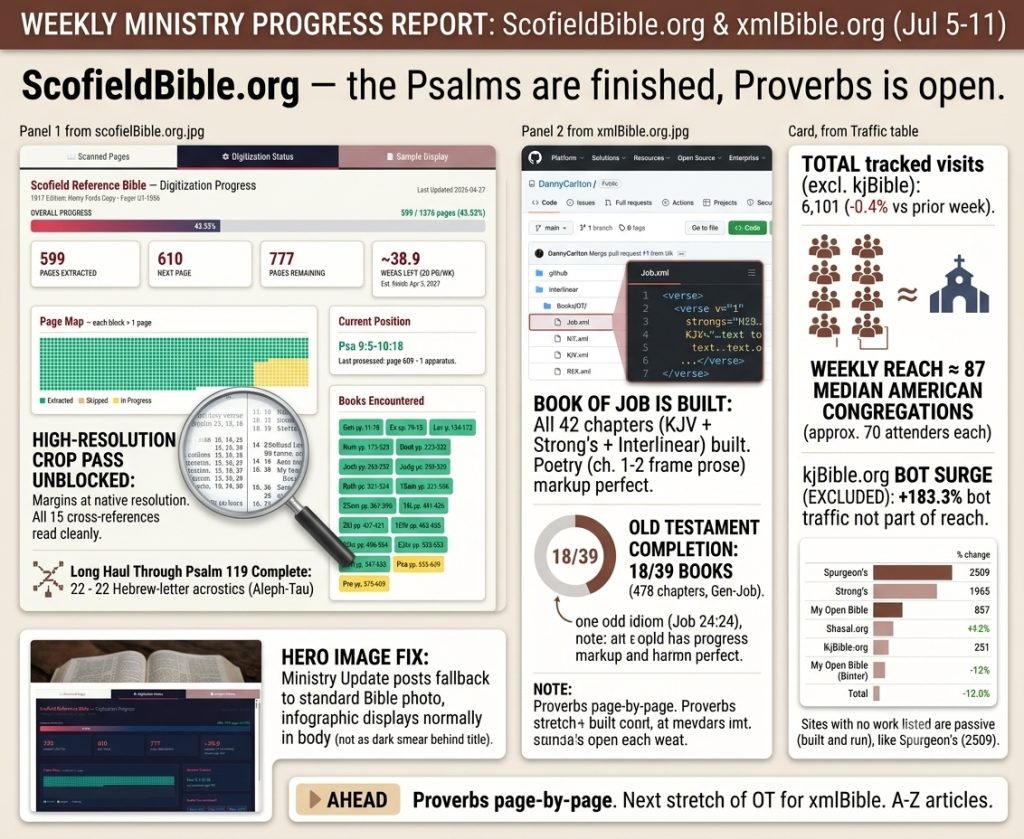
ScofieldBible.org — the Psalms are finished, Proverbs is open
The long haul through Psalm 119 is done: all twenty-two Hebrew-letter acrostic stanzas, Aleph through Tau. Psalms 120–132 followed, and then the rest of the Psalter. The extraction has now crossed into the book of Proverbs — the Scofield book introduction with its six-part outline, chapter 1 with its full margin apparatus, and on through chapter 7.
The other win this week was a tool, not a text. The center-margin cross-reference column on the dense Psalms pages was too small to read reliably, and I had wrongly concluded the scans themselves were the ceiling. They weren’t. A new crop pass now pulls that center strip at native resolution, and every one of the fifteen cross-references on the test page reads cleanly — including the tiny chapter-and-verse digits that had been defeating me. That unblocks the rest of the book.
xmlBible.org — the book of Job is built
All forty-two chapters, carrying the KJV text with Strong’s numbers, morphology, a word-level Hebrew interlinear, and Cambridge Paragraph Bible poetry markup. That brings the Old Testament to eighteen of thirty-nine books complete — 478 chapters, Genesis through Job.
Job was the real test. It is the first book where poetry is the default and prose is the exception, and the markup handled it correctly on the first pass: the prose frame (chapters 1–2 and the epilogue) came through as prose, and the dialogue cycles came through as verse. Both verification checks passed clean on every chapter, and the entire book produced exactly one oddity — an English idiom at Job 24:24 with no Hebrew counterpart behind it. The cleanest first pass of any book so far.
The blog itself — a hero image fix
Last week’s update was rendering its own infographic as a dark, illegible smear behind the post title, because the theme was using every post’s featured image as a full-bleed hero background. That works beautifully for a photograph and fails badly for a chart. Ministry Update posts now fall back to the standard Bible photo, and the infographic displays normally down in the body of the post, where it belongs.
This week’s traffic
| Site | Visits (Jul 5–11) | Prior week | Change |
|---|---|---|---|
| kjBible.org (see note) | 33,313 | 11,760 | +183.3% |
| Spurgeon’s Morning and Evening | 2,509 | 2,504 | +0.2% |
| Strong’s Concordance | 1,965 | 1,937 | +1.4% |
| My Open Bible | 857 | 960 | −10.7% |
| phpBible.org | 296 | 320 | −7.5% |
| Country Hymns | 164 | 114 | +43.9% |
| Matthew Henry’s Commentary | 131 | 108 | +21.3% |
| Nave’s Topical Bible | 53 | 43 | +23.3% |
| ScofieldBible.org | 49 | 50 | −2.0% |
| Did You Pray First? | 24 | 18 | +33.3% |
| SystematicTheology.us | 21 | 21 | 0% |
| Vocabularium | 20 | 24 | −16.7% |
| My Bible Memes | 9 | 18 | −50.0% |
| What My Dogs Taught Me Today | 3 | 6 | −50.0% |
| xmlBible.org | Not tracked — redirects to GitHub | ||
| osBible.org | Not tracked — redirects to GitHub | ||
| MorningPsalm.org | Absent from this week’s export — being looked into | ||
| VirtualBible.org | Absent from this week’s export — being looked into | ||
| Total, all tracked sites | 39,414 | 45,537 | |
| Total, excluding kjBible.org | 6,101 | 6,123 | −0.4% |
About kjBible.org. The overwhelming majority of that 33,313 is automated crawler traffic, not people. The 183% jump is a bot surge, not a revival. I exclude it from every reach figure below, and you should too.
About xmlBible.org and osBible.org. Both domains redirect to GitHub, so there is no analytics tracking on them at all. No visitor numbers exist for either one — which is a shame this week in particular, since xmlBible received the most substantial work of the lot.
About the sites with no work listed above. Most of these ministries are passive. They were built, and now they simply run — no maintenance, no updates, nothing from me in a given week. Spurgeon’s Morning and Evening quietly served 2,509 visits without my touching it once. That is the point of building them. A tool that only works when I am working on it is not much of a tool.
What the numbers actually mean
Set the bots aside, and the ministry sites drew 6,101 visits over the week — roughly 872 a day.
For a sense of scale: the most recent Faith Communities Today survey, released this past April by the Hartford Institute for Religion Research, puts the median American congregation at seventy weekly worship attenders. Measured against that number:
- Every day, these sites are read by about twelve median-sized churches’ worth of people.
- Every week, the total comes to roughly eighty-seven median congregations — a small denomination.
- A church of two thousand or more is classed as a megachurch. The weekly total is three times that threshold.
Now the honest part, because a number that flatters you is worth less than a number you understand. A “visit” is a browser session, not a soul. The same person looking up three passages on three evenings is counted three times. And a reader who spends forty seconds checking a cross-reference has not attended a worship service — not remotely. So this is not eighty-seven churches. It is eighty-seven churches’ worth of reach, which is a far thinner thing than eighty-seven churches’ worth of people.
Still worth knowing. The point was never the size of the number. The point is that free Scripture tools, sitting quietly on the open web, get used — by someone, somewhere, at two in the morning, looking up a verse.
Excluding kjBible, traffic was flat week over week: 6,101 against 6,123. No growth, no loss. Steady.
Ahead
Proverbs, page by page. The next stretch of xmlBible’s Old Testament. And the A–Z series, which is still owed some articles.