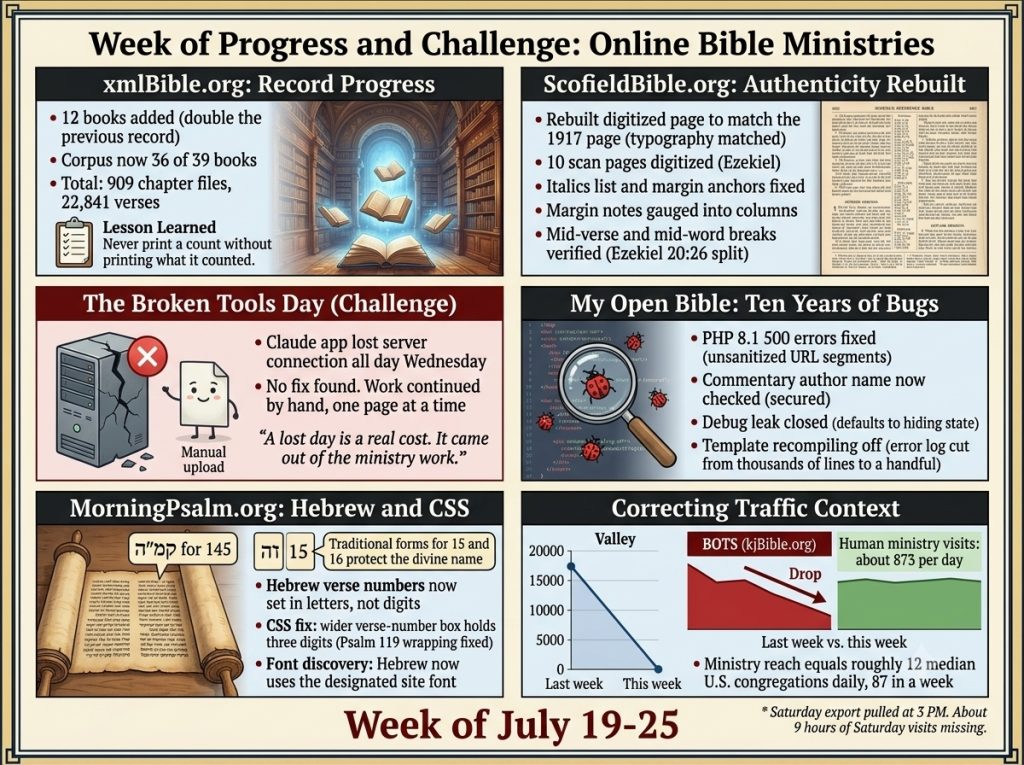
Twelve books of the Old Testament went into the scholarly XML Bible this week — nearly double the previous record week, putting the corpus at 36 of 39. The Scofield digitized page was rebuilt to look like the 1917 page it came from. My Open Bible had a decade of quiet bugs pulled out of it. And the better part of Wednesday went to a broken tool instead of to any of it.
xmlBible.org — twelve books in seven days
Lamentations, Ezekiel, Daniel, Hosea, Joel, Amos, Obadiah, Jonah, Micah, Nahum, Habakkuk, and Zephaniah — the Old Testament went from 24 books to 36, with only Haggai, Zechariah, and Malachi left. The corpus now stands at 909 chapter files and 22,841 verses, every one re-checked against the King James source rather than resting on what each build claimed about itself. Ezekiel produced the first markup fault in 26 books, at the very last verse: the source marks the divine name in “The LORD is there” without a Strong’s number, because Jehovah-shammah is a place name, and that one arrangement had no handler, so the formatting tag leaked into the verse as though it were Scripture.
The theme of the week was checks that pass by saying nothing. Ezekiel came back with no poetry across 48 chapters, laments included — verified as real only by running the same count against Lamentations, which found 288. Habakkuk’s closing psalm raised the same question, and it went to three separate sources rather than one check’s silence. Six new checks came out of that, and one lesson got written into the notes: never print a count without printing what it counted.
ScofieldBible.org — ten pages, and a page that finally reads like the page
Ten scan pages came in one run — printed pages 853–862, Ezekiel 13:22 through 21:21 — with roughly 110 margin anchors, eight Scofield outline headings, and every mid-verse page break verified against the KJV, including the mid-word split at Ezekiel 20:26.
The larger work was on how the digitized page renders. The layout engine had never been reading the KJV italics list recorded since page 484, so every page past that point showed supplied words as ordinary text. Margin notes anchored to a short word like “the” were attaching to the first “them” or “there” instead, and on any page spanning a chapter break, verse 1 of the new chapter collided with verse 1 of the old. Typography was then matched to the 1917 scan, and margin notes are now gauged into the height of the columns the way the original compositor had to do it.
The day the tools broke
Wednesday, the Claude app stopped being able to reach the file server. No warning, no clear cause, and most of the day went to looking for a fix that never turned up.
The work went on anyway, by hand — every scan page uploaded one at a time, every finished page downloaded and filed manually. It is a slow, fiddly way to work, but the ten-page Scofield run above was done entirely that way and the pace held. Worth saying plainly: a lost day is a real cost, and it came out of the ministry work, not out of anything spare.
My Open Bible — a decade of quiet bugs
The intermittent 500 errors all traced to one cause: URL segments dropped straight into database queries with no validation. Under the older PHP those failures were silent; under PHP 8.1 they became fatal, so a bug that had sat harmless for years started taking pages down — including on the site’s highest-traffic path. Worse, the commentary author name came from the URL and was pasted into a database table name unchecked, which is an open door. It is now checked against the list the file already defined.
There was also a debug leak: any hostname that was not literally “www” dumped the site’s internal state onto the page — database versions, table structure, cookies, the visitor’s IP, full filesystem paths. It defaulted to showing everything and made an exception for one host; it now defaults to showing nothing. Template recompiling had also been left switched on in production against the file’s own warning, and turning it off cut the error log from thousands of lines per page load to a handful.
MorningPsalm.org — Hebrew set the way Hebrew is set
The Hebrew column now follows the conventions of printed Hebrew Bibles: verse numbers in Hebrew letters rather than Arabic digits — קמ״ה for 145 — with the traditional forms at 15 and 16 so the numbering never spells out a divine name. Not a theoretical concern here, since Psalm 119 reaches verses 15, 16, 115, and 116.
Psalm 119 also exposed a display bug sitting unnoticed in the stylesheet: the verse-number box was a fixed 15 pixels wide, which holds two digits and no more, so every number from 100 up broke across two lines. Psalms 1 through 99 were fine, which is why nobody saw it. A larger discovery came with it — the Hebrew column had never been using the site’s font at all, since the font file covers Latin characters only, so every visitor was seeing whatever Hebrew face their browser happened to pick.
Traffic, week of July 19–25
| Site | Visits | Avg/day | Change |
|---|---|---|---|
| Spurgeon’s Morning and Evening | 2,554 | 365 | ▼ 0.1% |
| Strong’s Concordance | 1,660 | 237 | ▼ 11.6% |
| My Open Bible | 995 | 142 | ▲ 21.2% |
| phpBible.org | 222 | 32 | ▼ 3.9% |
| Country Hymns | 173 | 25 | ▼ 9.9% |
| VirtualBible.org | 148 | 21 | ▲ 111% |
| Matthew Henry’s Commentary | 92 | 13 | ▼ 15.6% |
| ScofieldBible.org | 64 | 9 | ▲ 3.2% |
| kjBible.org (bots gone) | 56 | 8 | ▼ 99.9% |
| MorningPsalm.org | 55 | 8 | ▼ 8.3% |
| SystematicTheology.us | 47 | 7 | ▲ 38.2% |
| Nave’s Topical Bible | 39 | 6 | ▲ 39.3% |
| Did You Pray First? | 32 | 5 | ▲ 52.4% |
| Vocabularium | 15 | 2 | ▼ 76.2% |
| My Bible Memes | 11 | 1.6 | ▲ 37.5% |
| What My Dogs Taught Me Today | 4 | 0.6 | — |
| BibleEngine.org | 1 | 0.1 | ▼ 66.7% |
| xmlBible.org | no data — redirects to GitHub | ||
| osBible.org | no data — redirects to GitHub | ||
| All sites | 6,168 | 881 | ▼ 86.2% |
Notes on the table. The export was pulled Saturday afternoon rather than at midnight, so roughly nine hours of Saturday are not in these numbers — a little under 6% of the week. Read the small decline accordingly. xmlBible.org and osBible.org redirect to GitHub and have no visitor statistics at all, which means the largest body of work this week again sits on a line with no number beside it. And most of these sites are passive ministries: built once, running unattended, needing nothing. A site can post real traffic with no work logged against it, and that is exactly the intent.
What the numbers actually mean
The 86% drop at the top of the table is one site and it is not readers. kjBible.org went from 38,491 visits to 56. That traffic was bots, and the bots have gone. The 56 visits left over are the first honest look anyone has had at what that site actually draws.
Setting kjBible aside, as always, the ministry sites drew 6,112 human visits for the week, or 873 a day — down about 3% from last week’s 6,317, on a week that was measured nine hours short. Call it flat.
The Hartford Institute puts the median U.S. congregation at 70 weekly attenders. On that measure these sites reach roughly 12 congregations’ worth of people every day, or about 87 congregations in a week.
The honest caveat stays where it belongs: a visit is a browser session, not a soul. Some are the same person twice. Some are thirty seconds and a bounce. But someone typed a word into a search box and landed on a Spurgeon devotional or a Strong’s entry, and that is not nothing.